
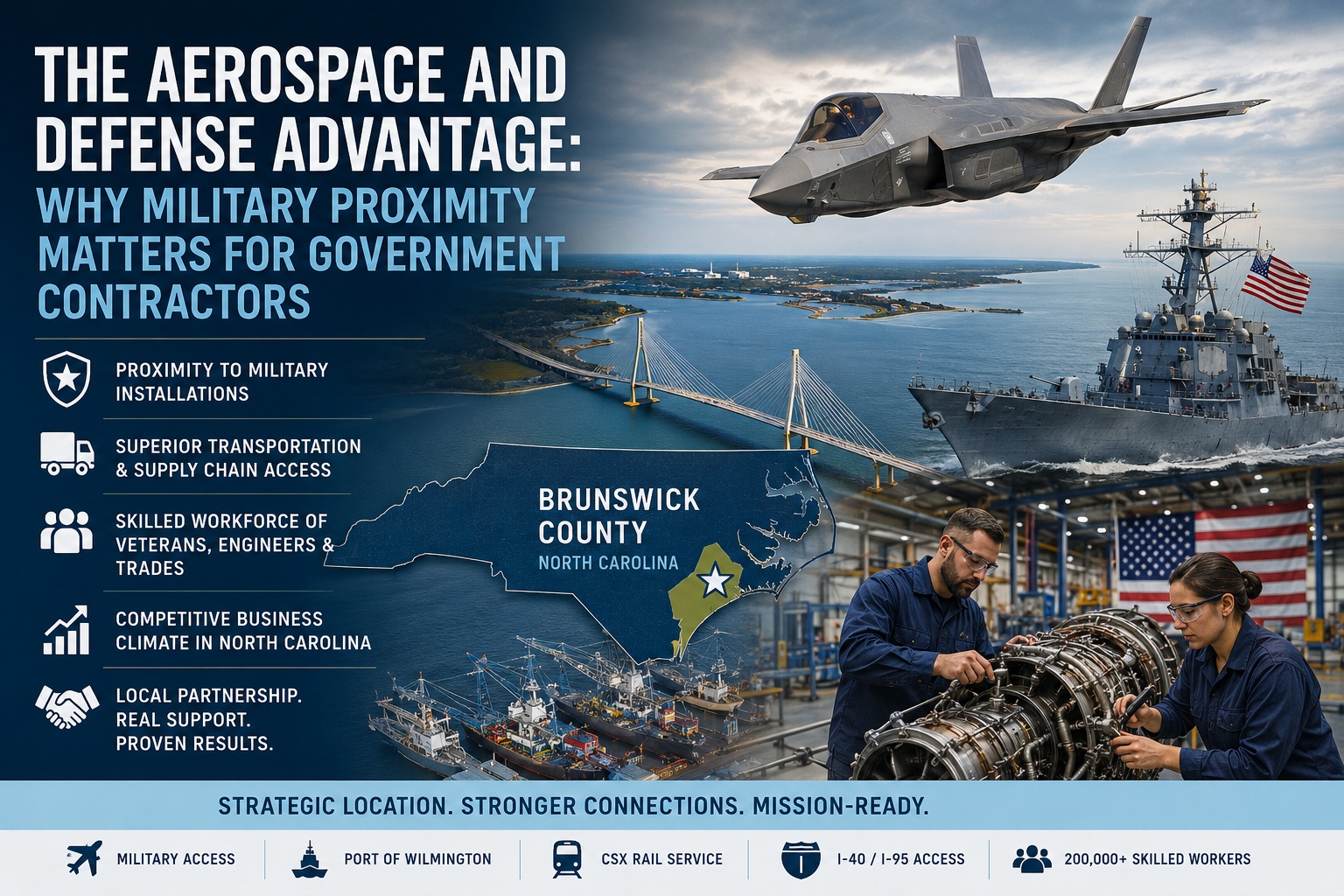
Location shapes outcomes in aerospace and defense in ways that don’t always show up in a spreadsheet. How close are you to the installations you serve? Can materials and personnel move efficiently? Is there a realistic pipeline of engineers, technicians, and skilled tradespeople you can actually hire? For prime contractors, subcontractors, and suppliers, these questions have real operational consequences — and the answers depend heavily on where you set up shop.
A lot of companies in this space have spent years in established defense corridors, absorbing the costs that come with them. Rising real estate, congested infrastructure, and labor markets stretched thin by competition from other industries. More are asking whether the advantages of those locations still justify the trade-offs and are looking at regions that offer genuine strategic value without the overhead.
Brunswick County in North Carolina has started showing up more frequently in those conversations. The combination of military access, transportation infrastructure, workforce development resources, and a genuinely competitive state business climate has made it harder to overlook for companies evaluating their next move.
Why Military Proximity Matters
Being near military operations isn’t just a symbolic advantage. For contractors and suppliers, it has tangible effects on how the business actually runs.
Logistics get simpler. Collaboration with installation personnel becomes more practical. Transportation costs for materials and equipment come down. And proximity to defense procurement activity — the people, the projects, the relationships — can open doors that are harder to reach from a distance.
There’s a workforce advantage as well. Defense corridors tend to concentrate the kind of talent aerospace and defense employers need: people with backgrounds in aviation, engineering, systems maintenance, logistics, and cybersecurity. Brunswick County’s position within the broader coastal North Carolina military landscape — connected to military aviation, maritime operations, and defense logistics networks across the region — puts companies here inside that ecosystem rather than on the edges of it.
That matters not just to large prime contractors but also to component manufacturers, maintenance providers, and technology firms that support them.
Transportation and Supply Chain Access
Defense and aerospace work runs on tight schedules. A logistics delay doesn’t just create inconvenience — it can affect production timelines, procurement obligations, and contract performance.
Brunswick County’s infrastructure was built for serious industrial use. Companies operating here have access to the Port of Wilmington for import and export activity, CSX rail service, major interstate and highway connections, and multiple airports covering regional, commercial, and international travel. That’s a logistics network that can actually handle what aerospace and defense operations demand — moving equipment, materials, and personnel without the bottlenecks that plague more congested markets.
Workforce: Veterans, Engineers, and Skilled Trades
Finding qualified people is the challenge most aerospace and defense executives talk about when you ask what keeps them up at night. Demand for engineers, machinists, fabricators, technicians, and cybersecurity professionals has outpaced supply in many of the traditional defense hubs.
The regional workforce picture in Brunswick County is more encouraging than in many comparable markets. There are more than 200,000 skilled workers in the broader region, supported by nearby universities, community colleges, and technical training programs producing graduates in engineering, manufacturing, logistics, and IT. Customized workforce training programs are available for employers who need to develop specialized skills that standard curricula don’t cover.
Veterans deserve particular mention here. Military personnel transitioning to civilian careers bring direct experience in aviation, logistics, maintenance, engineering systems, and leadership — exactly the background aerospace and defense employers need. Brunswick County’s proximity to military installations means that particular talent pool is local, not something you have to recruit from across the country.
North Carolina’s Business Climate
The state-level environment matters for companies managing long-term operational costs, and North Carolina’s numbers are competitive. The corporate tax rate is among the lowest in the country and is scheduled to keep dropping. The state has earned consistent national recognition for its business climate and economic competitiveness — not just in marketing materials, but in rankings that companies actually use when making site selection decisions.
For aerospace and defense businesses accustomed to operating in high-cost states or dense metro markets, the difference in carrying costs over a multi-year horizon is significant. Brunswick County itself is one of the fastest-growing counties in North Carolina, which means the infrastructure investment, industrial land availability, and economic development support are trending in the right direction.
Quality of Life Is a Real Recruiting Tool
Compensation matters, but it’s not the whole conversation anymore. Engineers, technicians, and skilled professionals weigh where they’re going to live — the commute, the cost, what the community actually offers — against what’s on the offer letter.
Brunswick County makes that part of the pitch easier. Coastal North Carolina location, lower cost of living, less congestion than major metro markets, and access to beaches and outdoor recreation. It’s a lifestyle that’s genuinely appealing to the kind of people aerospace and defense companies are trying to hire, including veterans who want to put down roots somewhere worth staying.
As hybrid and remote arrangements continue to shift, so does where people are willing to relocate. Regions that offer both professional opportunities and quality of life have a real advantage. Brunswick County increasingly fits that description.
Local Support That Actually Helps
An aerospace or defense relocation involves a lot of moving parts — site selection, permitting, infrastructure coordination, workforce planning, and incentive negotiations. Companies that try to navigate all of that without local knowledge tend to move more slowly and run into avoidable problems.
Brunswick Business & Industry Development works directly with companies through this process. That means involvement from the earliest conversations about whether the area is a fit, through site selection and build-out, and into ongoing expansion support. It’s not a referral list — it’s a team that stays engaged because the outcomes matter to them too.
Find Out How Brunswick BID Can Help
Aerospace companies, defense contractors, and government suppliers — are you close enough to the military installations, transportation networks, workforce pipelines, and procurement activity that define success in this industry?
Brunswick County puts companies in a strong position on all those fronts.
Contact us today because now is the time to bid on Brunswick.